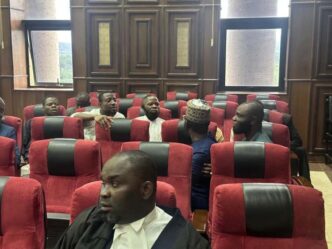
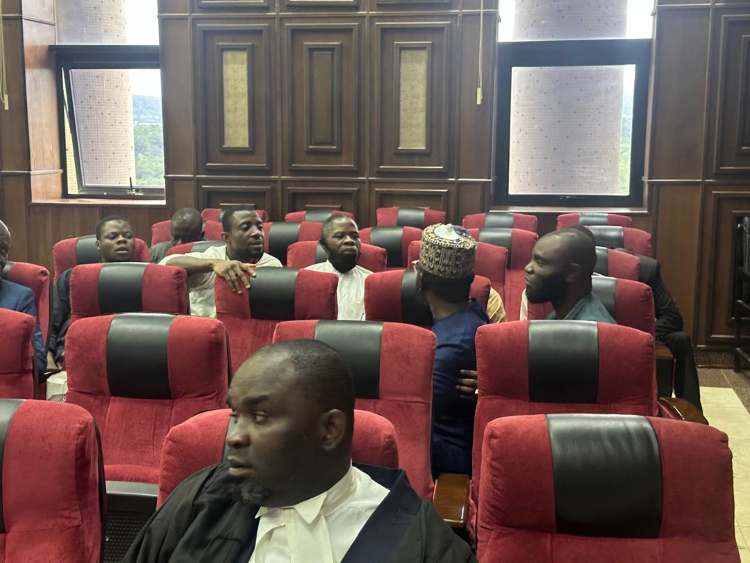
A Department of State Services (DSS) operative on Thursday told the Federal High Court in Abuja how digital forensic tools were deployed to track and arrest suspects linked to the June 5, 2022 attack on St. Francis Catholic Church in Owo, Ondo State.
Testifying before Justice Emeka Nwite, the witness, identified as SSK, said investigators relied on call geospatial network filtering, cell tower triangulation and International Mobile Equipment Identity (IMEI) analysis to trace the movement of the first defendant, Idris Abdulmalik Omeiza.
Led in evidence by Ayodeji Adedipe, counsel to the DSS, the witness said the agency filtered thousands of phone numbers that connected to cell towers in Owaluwa, Elegbeka and Ifon shortly before and after the attack.
“With these applications, we were able to filter thousands of mobile phones that had contact with the cell tower in Owaluwa, Elegbeka and Ifon,” the witness said.
“As a result of this, we narrowed it down to one of the defendants’ phone numbers. The defendant is identified as Idris Abdulmalik Omeiza (the first defendant).
“The system revealed a unique identification number, the International Mobile Equipment Identity (IMEI) associated with the 1st defendant’s phone.
“This number is a unique digital fingerprint associated with every phone, meaning that no two phones have the same IMEI.
“This enabled us to trace, locate and arrest the first defendant. His arrest and confession led to the arrest of other defendants.”
Omeiza, Al Qasim Idris, Jamiu Abdulmalik, Abdulhaleem Idris and Momoh Otuho Abubakar are facing terrorism-related charges over the attack.
The witness further told the court that analysis showed “bi-directional communication” between Omeiza and two other defendants — Jamiu and Al-Qasim — before and after the incident.
“These three individuals exchanged several communications before the incident, and after the incident, that is, between March 1, 2022, and July 30, 2022, within the space of six months,” he said.
Summarising the findings, the witness said the first defendant’s mobile phone was active within a 35-kilometre radius of the church around 7:23 a.m. on the day of the attack.
“Even though the first defendant applied no phone call rule, as a trained terrorist, his mobile phone was active. And, shortly after the attack, analysis revealed movement of the mobile phone towards Ifon,” he said.
“There is what is called a silent witness. The movement of the phone from one cell tower to another gave us an insight into the movement of the first defendant on pre-attack days and the day of the attack.
“Three of the defendants made several calls before and after the attack, which showed that they know one another and that their arrest is not by accident.”
He added that a black Tecno phone recovered from the first defendant matched the IMEI reflected in the call data records. The court admitted the digital forensic report and the mobile phone in evidence without objection from the defence.
Under cross-examination, the witness said it took over a month to locate and arrest the first defendant, who was apprehended in Eika, Kogi State. The suspects were arrested in August 2022 at various locations across Kogi and Ondo states.
Following the testimony of the 11th prosecution witness, DSS counsel announced the closure of the prosecution’s case.
Counsel to the defendants, Abdullahi Muhammad, said he would call only the suspects as witnesses and requested access to the fifth defendant’s statement and his clients, who are in DSS custody, to prepare their defence.
Justice Nwite adjourned the case to March 4 and 5 for the defence to open its case.