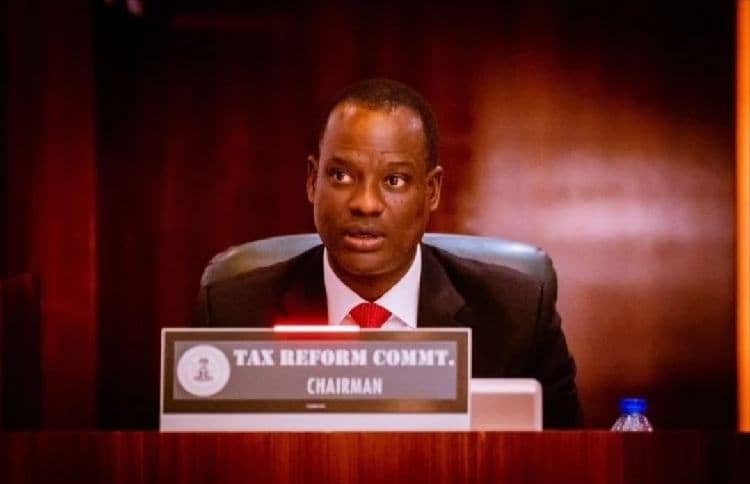
Taiwo Oyedele, chairman of the presidential fiscal policy and tax reforms committee, says the federal government will not sacrifice Nigeria’s future to shield those who have profited for years without paying taxes.
Oyedele spoke at the January business breakfast of the Franco-Nigerian Chamber of Commerce and Industry in Lagos, addressing resistance to tax reforms and Nigeria’s weak revenue performance.
He compared Nigeria’s tax collection to South Africa’s, noting that the country generated over N60 trillion from personal income tax alone in 2024.
The chairman said this figure exceeds Nigeria’s total tax revenue from all sources combined, including petroleum profit tax, corporate income tax, value-added tax, and taxes collected by federal, state and local governments.
“That is one tax from about 60 million people, compared to Nigeria’s 240 million people,” Oyedele said.
While acknowledging that South Africa’s per capita income is higher than Nigeria’s, he said Nigeria still has the potential to significantly increase personal income tax collection.
“If you take the top 60 million people in Nigeria based on income, it will be comparable to the per capita income of South Africa,” he said.
“Let’s say we can’t collect 60 trillion, why not 30? Guess how much we collected? It was under N3 trillion. Something is wrong, the math is not adding up.”
Oyedele said the large disparity explains why tax reforms face pushback from some quarters.
“This is one of the reasons why we find the motivation to keep going because the people fighting the reforms are not telling you why they’re fighting them. It is because they made money for so long, they never paid taxes,” he said.
“We are designing a system that says nobody will be above the law anymore. You will fight it because it is hard to pay tax anywhere in the world, we understand that but we will not compromise the future of the country because what is at stake is much bigger than any of us.”
Recall that President Bola Tinubu signed four tax reform bills into law on June 26, 2025.
The new tax laws will commence on January 1 despite calls for delays and suspension.