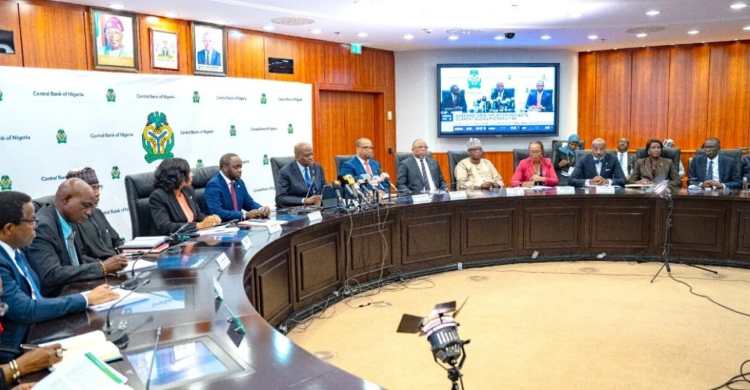
The Monetary Policy Committee (MPC) of the Central Bank of Nigeria (CBN) has maintained the monetary policy rate (MPR) at 27.5 percent, marking the third time this year that the rate has been held steady.
Olayemi Cardoso, governor of the CBN, announced the decision on Tuesday following the committee’s 301st meeting held in Abuja.
“The MPR is the baseline interest rate in an economy, every other interest rate used within the economy is built on it,” Cardoso explained.
The committee’s decision follows similar moves in February and May 2025, as the CBN continues to tackle inflation while maintaining economic stability.
Despite a slight increase in food prices, Nigeria’s inflation rate dropped to 22.22 percent, prompting the MPC to retain its current policy stance.
Speaking during a press briefing, Cardoso said the MPC voted to “retain the MPR at 27.50 percent, adjust the asymmetric corridor to +500 and -100 basis points around the MPR.” He added that the committee also maintained the cash reserve ratio (CRR) at 50 percent and the liquidity ratio at 30 percent.
Cardoso said the decision was made to “sustain the momentum of disinflation and sufficiently contain price pressure.”
He also stressed that the MPC would “continue to undertake rigorous assessment of economic conditions, price developments and outlook to inform future policy decisions.”
“The continued global uncertainties associated with the tariff wars and geopolitical tensions could further exacerbate supply chain disruption and exert pressure on the prices of imported items,” Cardoso noted.
He added that the country’s banking system remained stable, with “stable financial soundness indicators, which would further be supported by the ongoing banking recapitalisation exercise.”
Cardoso welcomed the drop in headline inflation from 22.97 percent in May to 22.22 percent in June, attributing the decline to “the moderation in energy prices and stability in the foreign exchange market.”
However, he warned of emerging risks.
“Despite these positive developments, members observed the uptick in month-on-month headline inflation, suggesting the persistence of underlying price pressures,” he said.
He reiterated that “continued global uncertainties associated with tariff wars and geopolitical tensions could further exacerbate supply chain disruption and exert pressure on the prices of imported items.”
‘GROSS EXTERNAL RESERVES NOW AT $40.1 BILLION’
Cardoso also pointed to “sustained stability in the foreign exchange market,” citing increased capital inflows, improved crude oil production, growth in non-oil exports, and reduced imports.
He stated that gross external reserves stood at $40.11 billion as of July 18 — enough to cover about 9.5 months of imports.
“The external sector also remains stable and resilient despite persistent uncertainties in the global macroeconomic environment,” he said.
Looking ahead, Cardoso said staff projections suggest inflation will continue to decline in the coming months, driven by tight monetary policy, stable exchange rates, lower PMS prices, and the start of the harvest season.
“Given the persistent uncertainty in the policy environment and underlying price pressures, monetary policy will need to maintain its current stance until risks to inflation recede sufficiently,” he added.
Cardoso reaffirmed the MPC’s commitment to “the bank’s price stability mandate” and pledged it would “take appropriate measures to foster stability and confidence in the economy.”
The next MPC meeting is scheduled for September 22 and 23.