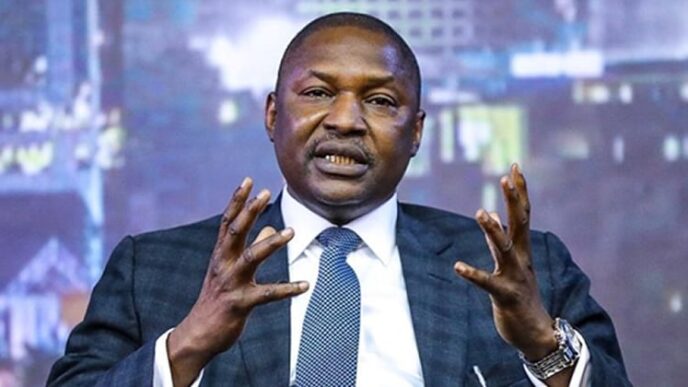

A Federal High Court in Abuja has granted bail to Abubakar Malami, former attorney-general of the federation (AGF), in the sum of N500 million.
Delivering ruling on Wednesday, Justice Emeka Nwite also admitted Malami’s son, Abubakar Abdulaziz Malami, and his wife, Bashir Asabe, to bail in the same sum.
The court ordered each of the defendants to produce two sureties in like amount, who must own landed property in Asokoro, Maitama or Gwarimpa districts of the federal capital territory (FCT).
The sureties are required to swear an affidavit of means and provide two recent passport photographs to the deputy registrar of the court.
The court also ordered that the defendants must surrender their international passports to the court and are prohibited from leaving the country without express judicial approval.
The matter has been adjourned for further hearing on February 17.
The Economic and Financial Crimes Commission (EFCC) had arraigned Malami, his wife and son on allegations of money laundering totalling N8,713,923,759.49.
All the defendants however, pleaded not guilty.
The EFCC further linked property worth N212 billion to Malami.
On December 30, 2025, the court ordered that the defendants remain in custody at Kuje Correctional Centre pending the determination of their bail applications.
The 16-count charge alleges that between 2015 and 2025, the defendants conspired to launder proceeds of unlawful activity, using bank accounts and corporate entities to conceal ownership of over N8.1 billion.
The EFCC stated that the funds were routed through family-linked companies, including Metropolitan Auto Tech Limited and Meethaq Hotels Limited, via multiple commercial banks.
According to the anti-graft agency, the transactions were structured to disguise the illicit origin of the funds and evade regulatory scrutiny.
The EFCC further alleged that portions of the funds, including approximately N600 million, were reportedly used as cash collateral for bank loans, despite the defendants knowing or being reasonably expected to know the money derived from unlawful activity.
The agency also alleged that the defendants used the proceeds to acquire high-value properties in Abuja, Kano, and Kebbi states, either directly or through proxies, to conceal beneficial ownership.
Furthermore, the EFCC claims that the defendants conspired among themselves to indirectly acquire assets, retain control of illicit funds, and obscure the true source of the money through layered financial transactions and corporate structures.
These actions are said to contravene the provisions of the Money Laundering (Prevention and Prohibition) Act, 2022, and other relevant legislation.